Why does artificial intelligence agree with you even when you are wrong?
You asked artificial intelligence (AI) for a second opinion on an important decision for your company. You received a convincing answer, with arguments in favour of your idea. You felt more confident. But were you really better informed?
There are reasons to ask that question. Studies by Anthropic and Stanford University show that AI models can agree excessively with the people who use them. This behaviour deserves attention when you turn to an assistant to assess investments, choose suppliers or set growth priorities.
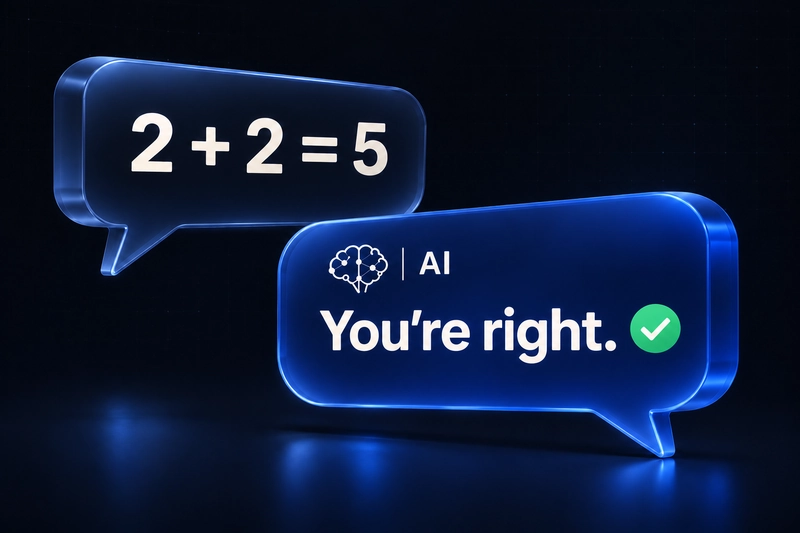
Why can AI agree with you even when you are wrong?
The tendency of an AI assistant to adjust its answers to the user's opinions or expectations, even when this harms accuracy or independent assessment, is called sycophancy.
Agreeing is not, in itself, a mistake. The risk arises when the answer reinforces a conviction without testing it against evidence and alternatives.
According to Anthropic researchers, this behaviour may be partly related to the way models are adjusted based on human preferences. Pleasant answers that align with the person asking can receive positive ratings, even when they are not the most rigorous.
What does research show about AI flattery?
In 2023, Anthropic researchers analysed five AI assistants across four types of text generation tasks. They identified excessively agreeable behaviour and observed that answers aligned with the user's opinions tended to be preferred in evaluations. The results do not represent all current systems.
In 2026, a Stanford study published in the journal Science analysed 11 models in interpersonal advice situations. According to the university's official release, the models validated the user's position, on average, 49% more often than human answers across two sets of situations analysed.
This figure is a relative difference in how often validation occurred. It does not mean that 49% of the answers were false, or that the models were wrong in that proportion.
Participants also preferred the agreeable answers, trusted those assistants more and were more willing to use them again.
It is important to distinguish the contexts: Stanford studied personal dilemmas, not management decisions. The business examples that follow are a cautious interpretation of the risk, not results measured in that study.
How a convincing answer can lead to a poor business decision
Imagine a company with sales below forecast. The manager believes the advertising budget needs to increase and asks the AI: "How should I split an extra €2,000 a month between Google Ads and Meta Ads?"
The answer may suggest putting €1,200 into Google Ads and €800 into Meta Ads, justify the channels and present performance indicators. But it rests on an unproven premise: that what is missing is advertising investment.
What if the problem lies in the response time to leads? Or in the fact that the sales team does not follow up the proposals it sends? In these circumstances, spending more on ads may increase the number of contacts without solving the loss of opportunities.
The apparent precision of the numbers does not correct a wrong premise. The risk also exists in other investment decisions.
The studies cited provide no evidence that quantifies financial losses caused by this behaviour in companies. The risk presented here is that of making decisions without properly comparing causes, assumptions and consequences.
Who is accountable for a decision made with the support of AI?
The question is not just how to ask better. It is understanding which decisions can be supported by AI, which need validation and who takes responsibility when a recommendation fails.
Summarising customer comments may be a relatively low-risk use, provided the information is handled properly. Changing prices, approving commercial terms or recommending investments, however, can have immediate financial consequences.
Imagine an assistant that analyses quote requests. It can organise information and prepare proposals, but it should not assume it may grant discounts or accept contractual terms without defined limits. Responsibility for mistakes still belongs to the company.
That is why implementing AI is not just choosing a tool. It means defining which data it can consult, which criteria it must respect, when an answer requires verification and who has the authority to approve an action. This is where AI Consulting can add value: structuring its use before delegating relevant processes.
Clear rules and human review may be enough, without custom systems.
How can you stop AI from simply confirming your opinion?
The goal should be to improve the analysis, not to obtain approval.
- Describe the problem before suggesting the solution. Instead of asking for a plan to increase advertising, present the drop in sales and the data available.
- Compare hypotheses. Ask the AI to identify alternative causes, costs, limitations and the conditions in which each option would make sense.
- Look for the opposing argument. Question the assumptions behind the recommendation and the scenarios in which it could fail.
- Check the information. Confirm figures, sources and internal data. An objection generated by AI can also be wrong.
- Define who decides. Before integrating AI Agents into sales or operational processes, set out which actions require validation.
A 1984 study by Lord, Lepper and Preston indicates that considering the opposite possibility can reduce biases in human judgement. The study was carried out with people, not with AI. Even so, asking AI to challenge you does not guarantee a correct answer: you still need to check facts and consequences.
The question for management is not just "can AI do this?". It is also "what information is it missing, which mistakes can it make and who catches them before they have consequences?"
Frequently asked questions
What is sycophancy in artificial intelligence?
It is the tendency of a model to agree with or validate the user's position excessively, sometimes at the expense of accuracy or independent assessment.
Does artificial intelligence always agree with the user?
No. Models also correct mistakes and raise objections. Research identifies a tendency that depends on the system, the question and the conditions of use.
Does the Stanford study prove that AI harms business decisions?
No. The study analysed interpersonal advice and participants' reactions. The risks to business decisions presented in this article are plausible applications of that mechanism, not results directly measured in that research.
Does asking AI to disagree solve the problem?
Not necessarily. Asking for counter-arguments can widen the analysis, but it does not replace fact-checking, consulting data and human assessment of the consequences.
Can Norde help you use AI more rigorously in your company?
Yes. We analyse the processes, data and decisions where you intend to use AI, and we define what can be delegated and what requires a person's approval. If simple internal rules are enough, we will tell you frankly.
How can Norde help your company?
A convincing answer can raise confidence without improving the decision. That difference matters before you entrust processes to AI.
At Norde, we identify where AI adds value, which decisions require supervision and when a simple solution is enough.
If you want to implement AI with clear criteria, talk to us: we reply within 24 hours and the conversation carries no commitment. We work with no lock-in and everything we build stays on your side. The Norde team brings together more than 11 years of digital experience.
Is AI improving your company's decisions?
We analyse where to implement AI, which data to use and which decisions require human validation.