Meta Ads or Google Ads: where should your company invest?
Does your company want to invest in ads but is unsure whether to choose Meta Ads or Google Ads? Popularity does not decide. It depends on how customers discover your offer, the moment when they look for a solution and your ability to turn interest into sales.
Before splitting the budget, identify which behaviour you want to capture: demand that already exists, or the attention of people who are not yet looking for your company.
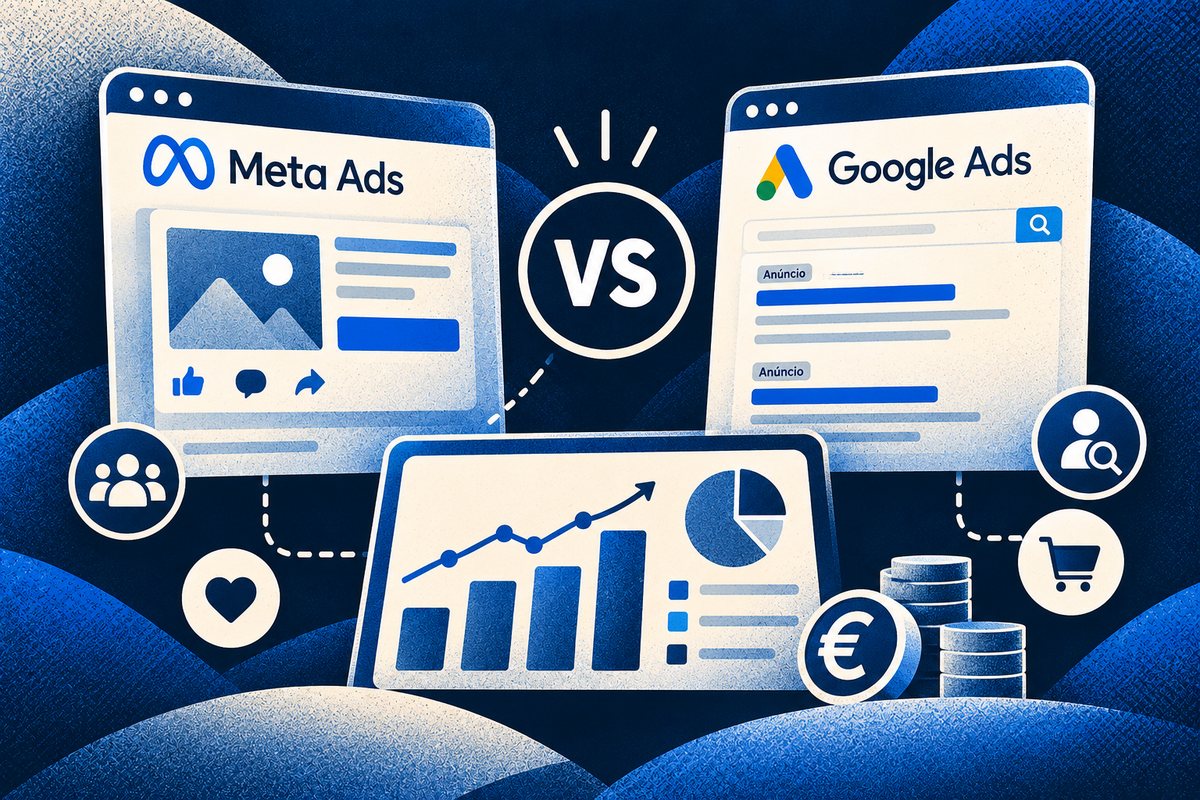
What is the difference between Meta Ads and Google Ads?
The main difference lies in the context in which the ad meets the potential customer. Google Ads can show ads linked to specific searches; Meta Ads lets you reach audiences while they use platforms such as Facebook and Instagram.
This does not mean that Google is only for selling or that Meta is only for promoting brands. Both platforms offer different formats and objectives, and the results depend on the offer, the setup and the commercial path.
When there is explicit demand
Imagine someone searching for "air conditioning maintenance company". If your company provides that service, a search ad can answer a need that the person has already expressed.
But intent does not guarantee a sale. The ad has to match the service, the page must clarify conditions and the contact needs to receive follow-up. A Lead Generation System links the ads to sales follow-up.
When you need to spark interest
Imagine a team organisation solution that many managers do not yet know. A visual ad can show the problem and present an alternative before anyone searches for the product.
In which situations does it make more sense to start with Google Ads?
Google Ads deserves to be assessed first when there are relevant searches for what the company sells and there is the capacity to respond quickly to that demand.
It can be a suitable option for services with an immediate need, products with features people search for or offers that people already know how to compare. The starting point is to understand what the real searches are, not just to choose generic keywords.
What should you validate before investing in Google Ads?
- Whether there are enough searches close to your offer.
- Whether you can tell informational searches apart from commercial intent.
- Whether the page clearly explains prices, conditions or next steps.
- Whether you can measure qualified requests and sales, not just clicks.
When may it be preferable to start with Meta Ads?
Meta Ads can be a starting point when the offer benefits from visual demonstration, discovery or an explanation of a little-recognised problem.
It is especially relevant to assess this approach when the company has images, videos or concrete examples that help the audience understand the value proposition. The message must be clear.
What should you validate before investing in Meta Ads?
- Whether you can explain the benefit quickly and understandably.
- Whether you have visual materials suited to the audience and the offer.
- Whether the page or the form lets you follow up on the interest.
- Whether you have a process to qualify contacts who are still exploring options.
Meta Ads or Google Ads: how do you compare without looking only at price?
Compare the platforms by the cost of acquiring suitable, profitable customers, and not just by the cost of generating traffic. A cheap click can bring little value; a more expensive contact may be justified if it leads to a sale with enough margin.
Criterion | Google Ads | Meta Ads |
|---|---|---|
Usual context | Can capture demand expressed in a search | Can generate discovery while content is being consumed |
Initial message | A clear answer to a searched need | Demonstration of the problem, benefit or product |
Main risk | Paying for poorly relevant searches | Generating interest without enough commercial intent |
What to measure | Qualified requests, sales and margin | Qualified contacts, sales and margin |
Essential condition | Relevant search and a consistent page | Relevant creative and commercial follow-up |
Illustrative example: two different costs per lead
Consider two campaigns with the same investment of €600. The first generates 30 leads and the second 15 leads. The cost per lead is, respectively, €20 and €40.
If the first campaign produces 2 customers and the second 3 customers, the acquisition cost will be €300 for the first and €200 for the second. These numbers are hypothetical and do not represent typical results of any platform.
The campaign with cheaper leads was not the one that won customers at the lowest cost. To decide, you still need to compare the margin of each sale, the time to close and the commercial costs.
Should you invest in both platforms at the same time?
Not necessarily. If the budget is limited and there is not yet a reliable measurement process, splitting the investment can make learning harder.
Start with the strongest commercial hypothesis, define what you consider a valid opportunity and track the result through to the sale. Once you have enough information, you can test the second platform or use it to complement the first.
For example, a company can capture searches with commercial intent and, at another moment, show content to people who have already shown interest, respecting the applicable privacy and consent rules.
What if neither is the priority?
If requests go unanswered, the page does not explain the offer or there is no way to identify the origin of sales, fixing those faults may bring more value than launching ads.
Frequently asked questions
Meta Ads or Google Ads: which generates more sales?
Neither platform guarantees more sales for every company. The choice depends on demand, the offer, the message, the commercial process and how results are measured.
Which is better for a company with a small budget?
It is generally more prudent to first test the hypothesis most closely tied to customer demand. Spreading a small budget across several campaigns can prevent useful conclusions.
Is Meta Ads only for building awareness?
No. It can support lead generation and sales, but you need to tell social interactions apart from actual commercial results.
Does Google Ads work if nobody searches for my solution?
A search campaign has limitations when there is no relevant demand. In that scenario, it may make more sense to first explain the problem and present the solution through other channels.
Can I use Meta Ads and Google Ads together?
Yes. The platforms can play complementary roles, as long as there is budget, follow-up and a consistent way to assess results without counting the same sale twice.
Can Norde help decide between Meta Ads and Google Ads?
Yes. We analyse demand, the offer, margin and the sales process to recommend where to start. The recommendation may include not investing in either yet, while the page or the follow-up of contacts is not ready.
How can Norde help your company?
Before choosing between Meta Ads and Google Ads, confirm where there is a concrete commercial opportunity and whether the company can follow contacts through to the sale.
At Norde, we look at Paid Media starting from demand, the offer and the commercial process. We recommend starting with the simplest, most verifiable option, even if that means improving a page or organising follow-up before investing in new campaigns.
If you do not know where to invest first, get in touch: we reply within 24 hours and the conversation is without obligation. We work without lock-in contracts and everything we build stays with you. The Norde team brings more than 11 years of experience in digital.
Not sure whether to invest in Meta Ads or Google Ads?
We analyse demand, the offer and sales to identify where to start.