Lead management: how much does it cost to lose opportunities through lack of follow-up?
Receiving contacts from potential customers does not mean having well-followed commercial opportunities. A lead can fill in a form, ask for a proposal and end up forgotten in an inbox, even when the interest is real.
The cost of this failure does not always show up in marketing reports. To understand it, you need to follow the journey from the moment a contact comes in to the sale, and identify where the team stops acting.
What is lead management and where are opportunities lost?
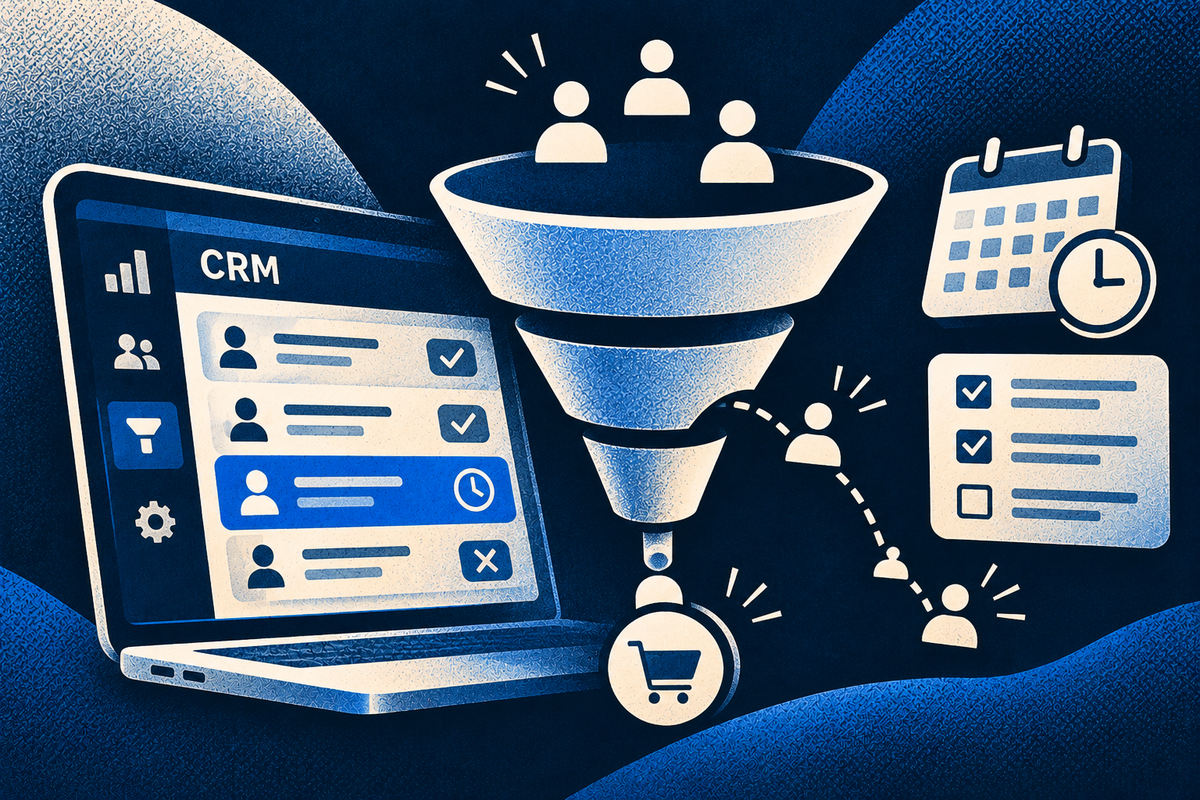
Lead management is the process of recording, qualifying, distributing and following up the contacts interested in the company. The goal is not to contact everyone repeatedly, but to make sure that every relevant opportunity has an owner and a defined next step. A Lead Generation System links the capture of contacts to this follow-up.
Signs that follow-up is failing
- Scattered contacts: forms, messages and emails are checked by different people.
- Undefined responsibility: nobody knows who should reply to a given lead.
- Proposals without follow-up: sending the proposal is treated as the end of the process.
- Incomplete information: the salesperson does not know the initial request or the history of conversations.
- No loss reasons: the company does not tell apart lack of interest, price, timing or follow-up failures.
How much does it cost to lose leads through lack of follow-up?
The cost can be estimated by combining the number of opportunities without follow-up, the probability of conversion and the margin earned per customer. It is an estimate of potential revenue or margin, not a guarantee of sales that would have happened.
Illustrative example: calculating the margin at risk
Imagine a company that receives 80 leads in a month. Of these, 20 do not get adequate follow-up. If comparable contacts that are properly followed up convert, on average, 15% into customers, we can build this scenario:
- 20 leads without follow-up × 15% = 3 potential sales.
- Average contribution margin per sale: €600.
- 3 × €600 = €1,800 of potential margin at risk that month.
This is an illustrative example, with hypothetical values. It does not mean that the three sales would have been completed: leads may have different levels of interest and the historical conversion rate may not apply.
Compare leads of a similar origin and profile before extrapolating the results.
What about the marketing investment?
In a paid campaign, the investment in acquisition has already been made. Without follow-up, it may not turn into sales.
However, cost per lead is not the same as cost per customer. To assess profitability, relate the investment to actual sales and to margin, not just to the forms received.
How do you organise follow-up without creating bureaucracy?
Start by defining simple, verifiable rules. A well-used spreadsheet may be enough for a small volume of contacts; a more complete system is only justified when the operation needs it.
Record the origin and the context
Each lead should have, at least, identification, contact details, origin, the need presented and the date of entry. Without context, the team repeats questions and loses continuity in the conversation.
Assign an owner and a next action
The contact needs an owner and a concrete task: call, send information, prepare a proposal or get back in touch on an agreed date. "Following up" is not a next action.
Define understandable commercial stages
A simple structure can distinguish new lead, contacted, qualified, proposal sent, won and lost. The stages should reflect real events, not just the salesperson's subjective perception.
Create a review routine
Set aside a regular moment to identify contacts without a reply, stalled proposals and overdue tasks.
When does a CRM make a difference?
A CRM (Customer Relationship Management) is a system for organising relationships with customers and commercial opportunities. It becomes especially useful when several people follow up leads, there are many contacts at the same time or it is hard to tell the status of each negotiation.
Solution | When it makes sense |
|---|---|
Spreadsheet | Few leads, a simple process and one disciplined owner. |
Existing CRM | A need for history, tasks, stages and shared visibility. |
Custom CRM | Specific processes that the available tools cannot adequately accommodate. |
A CRM does not, by itself, solve a lack of commercial discipline. If nobody updates the contacts or carries out the tasks, the information will remain incomplete.
In Norde's Custom CRM solution, the starting point is to design the commercial process before configuring the tool. This can include stages, responsibilities, integrations and indicators suited to the team.
And when does it make sense to automate?
Process automation can help route new contacts, create tasks or send reminders. But it should support a clear commercial rule, and not multiply automatic messages without relevance.
If the problem is the quality of the contacts, review the lead generation system.
Which indicators show whether the company is losing leads?
Start with a few indicators and track them by origin and owner, whenever possible.
- Leads received: unique contacts that came in during the period.
- Leads contacted: share with a first contact attempt recorded.
- Time to first contact: interval between entry and the first commercial action.
- Proposals without a next action: proposals sent without scheduled follow-up.
- Conversion into customers: closed sales against eligible opportunities, with consistent criteria.
- Loss reasons: documented reasons for not moving forward.
Frequently asked questions
What is the difference between generating leads and managing leads?
Generating leads is attracting interested contacts; managing leads is qualifying them and following them up until there is a commercial decision. They are complementary parts of the same process, but they need different indicators.
Should all leads get the same follow-up?
No. The priority and the type of contact should depend on the need presented, the interest shown and the fit with the service. Insisting indiscriminately can harm the potential customer's experience.
Is it mandatory to have a CRM to manage leads?
No. A small team can start with a shared record and clear rules. A CRM becomes more useful when the volume, the stages or the number of people involved make manual control difficult.
How can I tell whether a lead was lost through lack of follow-up?
It is not possible to be certain in every case. You can, however, identify contacts without a reply, proposals without a new action and differences in conversion between comparable opportunities, looking for patterns of failure.
Can Norde help organise lead follow-up?
Yes. We start from the sales team's current process and only then assess whether a well-organised spreadsheet is enough, whether to configure an existing CRM or to design a custom CRM. We recommend what is sufficient for your volume of contacts.
How can Norde help your company?
The first step is to make visible what happens after a potential customer gets in touch: who replies, when they reply and what happens next. Only then does it make sense to decide whether the problem calls for a tool, a change of process or both.
At Norde, we start from how the commercial team really works and from the opportunities that are being lost. If a simple procedure fixes the fault, we recommend that path; when the process needs more control, we design the right CRM solution, without adding unnecessary complexity.
If you want to know how many opportunities your company is leaving without follow-up, get in touch. We reply within 24 hours, with no obligation. There are no lock-in contracts or exit penalties, and accounts, data and systems stay with you.
Do you know how many opportunities go without follow-up in your company?
We analyse the sales process and help you build a follow-up system suited to your team.