Custom CRM: when does a traditional CRM stop meeting the company's needs?
A CRM (Customer Relationship Management) is a system used to organise contacts, sales opportunities and interactions with customers. But when the team starts working in parallel spreadsheets, copying information between platforms or working around the CRM itself, the question stops being merely technological: the sales process may be losing efficiency and opportunities.
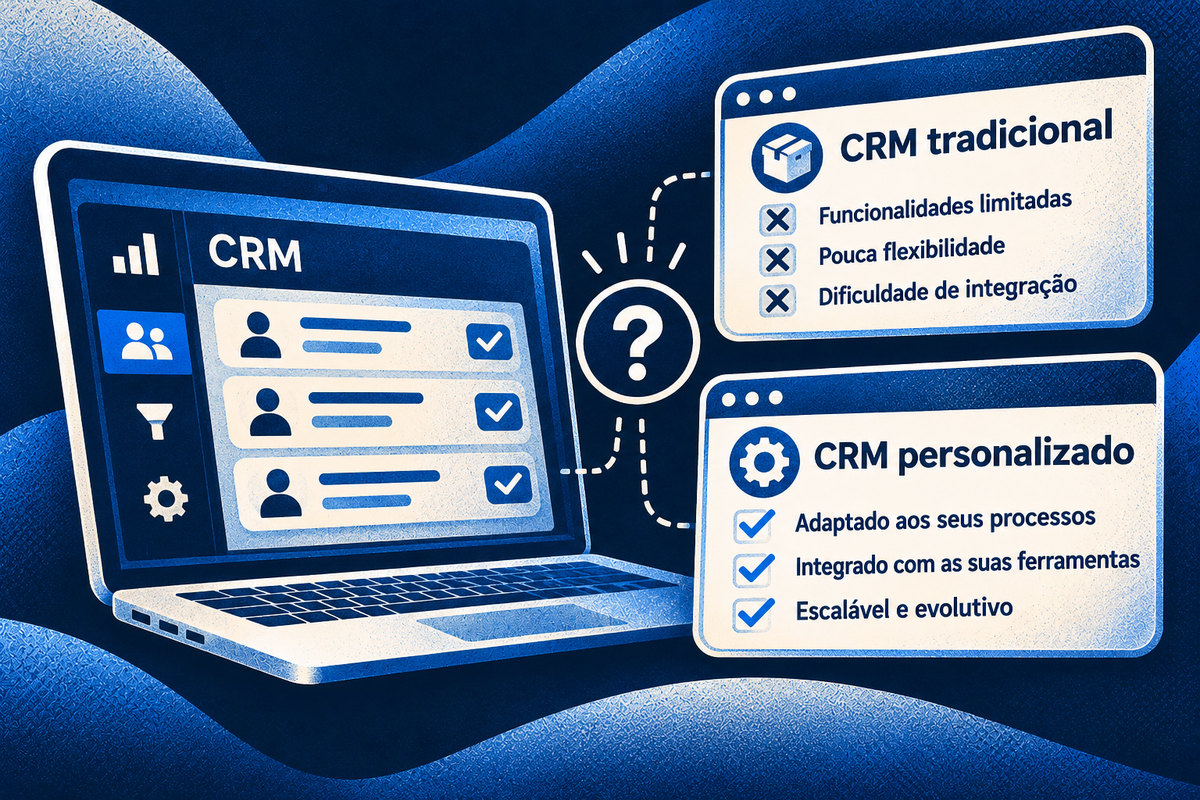
A traditional CRM can be enough for years. The problem appears when the company's processes become more specific and the tool stops keeping up with the way teams really work. Before investing in a custom CRM, it is important to understand whether the difficulty lies in the configuration, in how it is used or in a real limitation of the software.
Which signs show that the current CRM no longer meets the business's needs?
The most important sign is not the number of features available. It is the distance between the work that needs to be done and what the CRM lets you do without creating extra tasks.
The team keeps information outside the CRM
If salespeople need to check messages, spreadsheets and personal notes to understand the status of an opportunity, the CRM has stopped being a reliable source of information. This increases the risk of unanswered contacts, incomplete records and decisions made with out-of-date data.
There are repeated tasks between systems
Is the same information entered in the website form, in the CRM and in the invoicing program? Every manual transfer consumes time and creates opportunities for error. When these repetitions happen every day, the team no longer has the capacity to follow up customers.
It is not always necessary to replace the CRM. An integration between tools or process automation can solve the problem with less investment.
Sales follow-up depends on each person's memory
If a proposal is forgotten because the person in charge did not receive a reminder or could not see the pending tasks, the company does not just have an individual organisation problem. It lacks a shared process to define owners, deadlines and next steps.
Reports do not answer management's questions
How many opportunities are stalled? Where do the contacts that actually buy come from? How long does the handover between sales stages take? If the answers require hours of exports and cross-referencing data, management loses visibility over the business.
Why do companies reach this point?
The mismatch usually arises from small decisions that pile up. The company adapts to the tool to keep working, until those adaptations start to constrain the operation.
The sales process changed, but the CRM did not
A company may start with a simple process: receive the contact, present a proposal and close the sale. Later, different teams may appear, along with complex quote requests, internal approvals, recurring contracts or after-sales follow-up.
There are integrations that do not work as expected
Marketing captures contacts, the sales team works them and operations needs to follow customers after the sale. When each area uses an isolated platform, it is easy to lose information in the handover of responsibilities.
When is it worth adapting the existing CRM and when should you consider a custom CRM?
The decision should depend on the business requirements, the maintenance costs and the impact of the current limitations. A custom CRM is not automatically better than a market solution.
Situation found | Decision to assess first |
|---|---|
Missing fields or stages | Configure the existing CRM |
Inconsistent use by the team | Review processes, training and responsibilities |
Duplicated information across platforms | Integrate systems or automate transfers |
Specific sales flows without support | Assess extensions or a custom CRM |
Excessive reliance on spreadsheets | Identify the cause before replacing the tool |
Growing costs of adaptations and licences | Compare the total cost of the alternatives |
When configuration can solve the problem
If the CRM already offers customisable fields, automatic tasks, permissions and suitable integrations, it may make more sense to organise the operation within those capabilities. The gain often lies in simplifying the process, not in acquiring a new platform.
When a custom CRM may make sense
A custom CRM deserves consideration when the operation requires rules, integrations or journeys that the current software cannot adequately support. This is the case for sales processes with several teams, specific validations, different types of customer or complex operational dependencies.
What to compare besides the initial price
Consider the costs of implementation, data migration, training, hosting, support, evolution and maintenance. A tool that is cheaper at the start can become expensive if it requires constant adaptations; a solution of your own can also be an unnecessary burden if the process is simple.
How do you prepare a decision without interrupting sales operations?
Start by identifying where opportunities and time are lost. Then organise the requirements into three groups: essential, useful and dispensable.
Map the journey from a contact to the sale
Record how an opportunity comes in, who receives it, what the decision stages are, what information should accompany each stage and when responsibility changes hands.
Test a limited improvement first
Before migrating all contacts, choose a measurable problem: proposals without follow-up, duplicate records or recurring manual tasks. Fix that point, observe the result and use what you learn to decide whether a deeper change is needed.
Frequently asked questions
Is a custom CRM always better than a traditional CRM?
No. A well-configured traditional CRM can fully meet the company's needs. Customisation only pays off when it solves relevant limitations that cannot reasonably be overcome with the existing solution.
How can I tell whether the problem is the CRM or the team?
Observe the tasks the team carries out outside the system and ask why. If the problem comes from a lack of training or unclear rules, fix those factors before replacing the software.
Is it possible to integrate the current CRM with other tools?
Often, yes. Feasibility depends on the features and integration interfaces available in each application. Confirming this possibility can avoid unnecessary development.
Do you have to lose data when changing CRM?
No, but a migration requires planning. It is important to assess the quality of the records, define what information should be kept and test the transfer before abandoning the previous system.
How much does it cost to develop a custom CRM?
The cost depends on the sales flows, the integrations, the users and the maintenance needed. Without knowing those requirements, any figure would be of little use for a responsible decision.
Can Norde help decide whether I need a custom CRM?
Yes. We start from the sales process and assess whether configuring or integrating the current CRM is enough. We only recommend a custom CRM when the limitations are real and justify the investment.
How can Norde help your company?
If the CRM is creating extra work or making it harder to follow up customers, start by identifying where information is lost and which tasks stop the team from moving forward. A diagnosis of the sales process lets you tell a usage problem from a technological limitation.
At Norde, we start by understanding how commercial opportunities arrive, are followed up and turn into sales. From there, we assess whether it is enough to configure or integrate the current tools, automate a few steps or develop a custom CRM; we recommend the simplest solution that answers the company's real problem.
If your CRM is making commercial work harder, get in touch: we reply within 24 hours and the conversation is without obligation. We work without lock-in contracts and everything we build stays with you.
Is your CRM making commercial work harder?
We analyse your process and help you work out whether you need to improve, integrate or replace your current CRM.