AI in companies: why does investing in tools not guarantee results?
Does your company already use artificial intelligence tools but still work in much the same way? Investing in AI in companies does not guarantee results when the technology is introduced without a defined problem, a prepared process and a way to measure the impact.
Turning tools into improvements requires decisions about people, tasks and responsibilities.
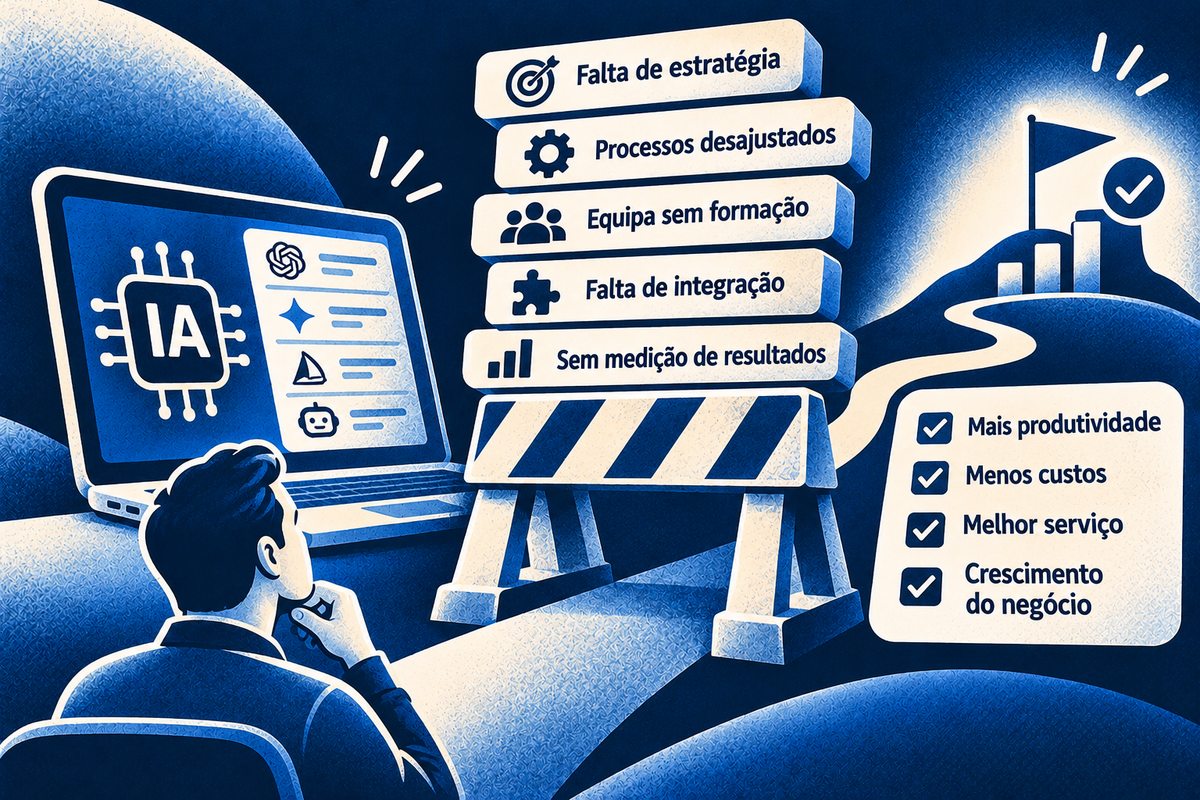
Why is buying AI tools not enough?
Because a tool does not, by itself, fix a poorly organised process. It can speed up an isolated task and still not improve the final result for the customer or for the company.
If AI speeds up writing proposals but approval is still slow, the response time may not improve.
The problem was in the whole process.
What are the most common obstacles to getting results?
The obstacles often appear outside the technology. Check whether the team can use it consistently.
1. There is no concrete problem to solve
"We want to use AI" is an intention, not an operational goal. It is more useful to ask: "Why do we take so long to reply to quote requests?" or "Why do we enter the same data again in several systems?".
From there, it is possible to assess whether AI is suitable or whether changing a working rule is enough.
2. The current process is poorly defined
If every employee carries out the same task differently, automating that task can reproduce the confusion. First, identify inputs, decisions, owners and expected results.
The essential steps should be clear.
3. The team does not know when to trust the answer
Generative AI, a technology that produces text, images or other content from instructions, can give convincing but incorrect answers. The team needs to know what it can delegate, what it must confirm and when human review is necessary.
Training should address the limits of the tool in real work.
4. The information is scattered or out of date
A tool that works with old documents, contradictory tables or incomplete data can produce poorly useful answers. Integration does not automatically fix data quality.
Start by identifying which data is needed and who ensures it is kept up to date.
5. Nobody measures the result
If the only metric is the number of employees with access to the tool, you cannot conclude that the investment paid off. You need to observe what changed in the process and what that change cost.
How do you choose a use case with potential?
Start with a repeated task, with a relevant impact and a result you can assess. Avoid choosing the first project just because it looks technologically impressive.
Which questions should you ask before going ahead?
- Frequency: how often does this task occur?
- Effort: how much time does it take and from whom?
- Quality: which errors or delays happen today?
- Information: is the data needed available and reliable?
- Risk: what would be the consequences of an incorrect answer?
- Responsibility: who validates the result and maintains the solution?
These answers help identify useful opportunities.
Situation found | First decision to consider |
|---|---|
Simple, infrequent manual task | Improve the procedure before investing in technology |
Repetitive work with fixed rules | Assess conventional automation, without generative AI |
Frequent analysis of unstructured information | Test AI with human validation and quality criteria |
Contradictory information between systems | Fix data and integrations before adding AI |
Critical process with no defined owner | Clarify responsibilities and controls first |
AI Consulting can help assess priorities, but it is not mandatory to test a small, controlled improvement.
How do you calculate whether the AI investment pays off?
Compare the total cost of the solution with the benefit you can observe. Include licences, setup, training, human review, maintenance and any corrections.
Illustrative example
Imagine that a team prepares 80 documents a month and takes, on average, 20 minutes on each. A test with AI reduces the initial preparation to 12 minutes, but requires 3 additional minutes of review per document.
The net saving is 5 minutes per document: 80 × 5 = 400 minutes a month, or 6 hours and 40 minutes. This is potentially freed-up time, not an automatic cost reduction.
If the tool and its maintenance cost more than the useful value of that time, the investment may not pay off. You should also check that the quality of the documents was maintained and that the freed-up time was actually put to use.
When should you integrate AI into the company's processes?
When the test shows usefulness, there is an owner and the risks are under control. Only then does it make sense to assess a deeper integration with the existing systems.
Start with a limited test
Choose one process, a small group of users and an evaluation period. Record how the work was done before and compare the results with criteria defined in advance.
Before using confidential data, check access, terms of use and data protection.
Decide what to keep, fix or abandon
A test that does not improve the result is also useful: it avoids scaling up an unsuitable solution. It can reveal that the biggest gain lies in a change of process, a simple integration or a tool the company already pays for.
Do not turn a pilot project into an obligation to buy. The decision should depend on the evidence gathered, not on the initial enthusiasm.
Frequently asked questions
Does artificial intelligence always increase productivity?
No. It can reduce the time of some tasks, but it can also add review, corrections and coordination. The effect should be measured across the whole process.
Does an SME need to develop its own AI solution?
Not necessarily. A feature already included in the existing software may solve the problem at lower cost and complexity.
How can I tell whether the team is using AI well?
Observe the quality of the work, the consistency of the procedures and the results obtained. The number of accesses to the tool, on its own, says little.
Is it better to automate first or to implement AI?
It depends on the task. If the rules are clear and stable, conventional automation can be simpler and more predictable. AI makes more sense when it adds a capability that those rules do not offer.
How long does it take to get results with AI?
There is no universal timeframe. It depends on the complexity of the process, the quality of the information, the team's preparation and the criteria defined for the test.
Can Norde help assess where AI makes sense in my company?
Yes. AI Consulting identifies where AI can increase productivity and where it does not pay off to invest, with a concrete plan. The recommendation is independent: it does not oblige you to implement any project with Norde.
How can Norde help your company?
The first step is not to choose a tool: it is to identify a task whose result needs to improve and to establish how that improvement will be assessed.
At Norde, we start from the process, the limitations and the business goals. From there, we recommend the simplest solution that makes sense, even if that means reorganising the work or taking advantage of an existing feature, without developing a new AI system.
If you want to know where AI makes sense in your company and where it does not pay off, we can start with a conversation, with no obligation and a reply within 24 hours. We work without lock-in, and the aim is for your company to become more capable, not more dependent on us. The Norde team brings more than 11 years of experience in digital.
Has your company invested in AI but still cannot assess the return?
We analyse the processes and identify where AI can solve a concrete problem.