7 signs that management software is limiting growth
Management software should help the company work better. But when operations grow, a tool that used to be enough can start to create delays, duplicated work and decisions made with incomplete information.
These 7 signs that management software is limiting growth help you tell a configuration problem apart from a real limitation of the solution. The goal is not to switch systems on impulse: it is to understand the operating cost of carrying on as you are.
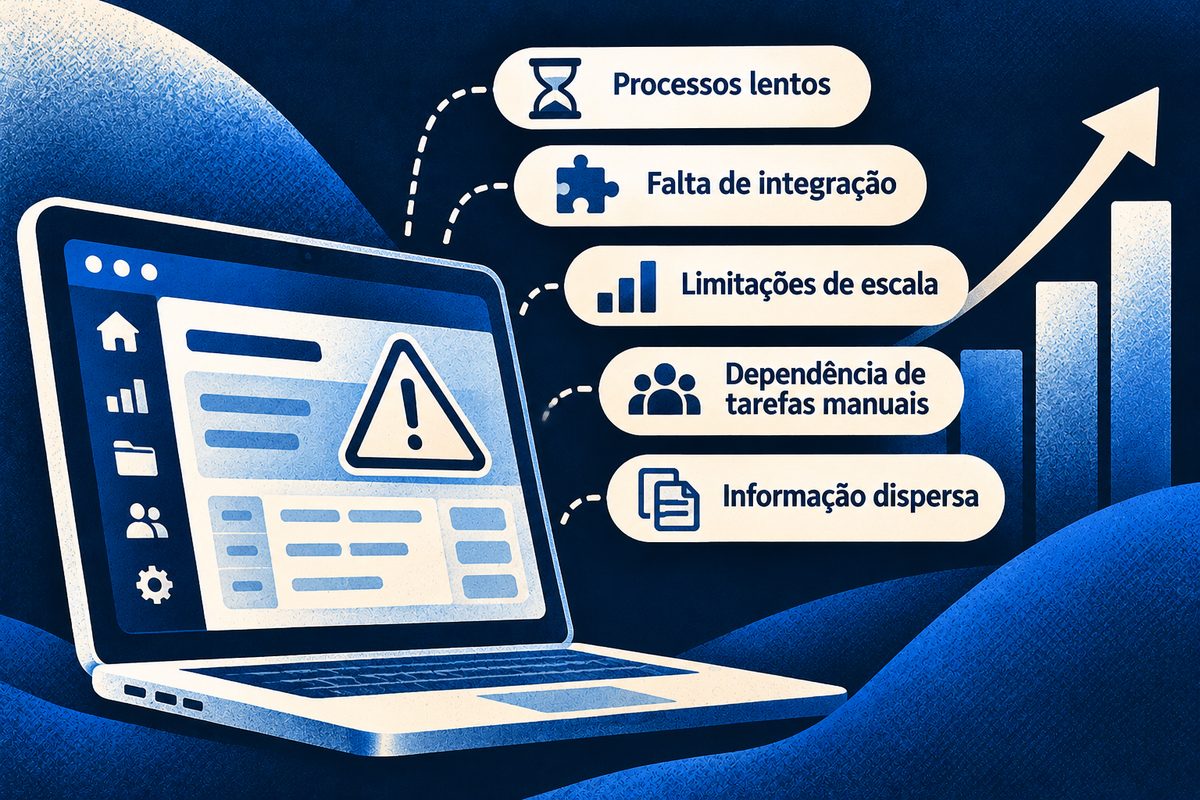
How can you tell whether management software is holding the company back?
The most important sign is not the age of the program, but the distance between what the team needs to do and what the system lets it carry out safely and efficiently.
If the company depends more and more on parallel spreadsheets, manual checks or improvised workarounds, it is worth investigating.
7 signs that management software is limiting growth
1. The team enters the same data several times
When the same information is copied between invoicing, sales and operations, administrative work and the risk of inconsistencies increase.
Identify where data is first entered and who fills it in again. An integration between systems can solve the problem without replacing the existing applications.
2. Reports arrive late or cannot be trusted
If every meeting requires putting several files together to know sales, orders or costs, the information is not accessible enough.
Check whether the indicators you need already exist in the system and are configured correctly. If not, assess a simple way to consolidate the data before investing in a new platform.
3. Processes depend on one specific person
When only one employee knows how to export data, fix errors or complete a given operation, there is an operational dependency.
Document the procedure and test whether someone else can carry it out. If the difficulty persists because the software requires too many manual operations, it may be necessary to simplify the flow or automate part of it.
4. The tool does not keep up with new needs
The company adds services, teams, sales channels or approval rules, but the software keeps imposing the old process.
Before concluding that you need custom development, check the modules, permissions and settings available.
5. The systems do not talk to each other
A confirmed sale may require separate updates in inventory, invoicing and customer follow-up.
Map the data that needs to flow and how often. A well-defined systems integration can be cheaper and less risky than replacing the whole infrastructure.
6. Small changes become lengthy projects
Adding a field, changing an approval or creating a report may require requests to the supplier, external work and long waits.
Tell occasional changes apart from recurring needs. If every essential change requires working around the tool, the software's flexibility has become a decision factor.
7. Growth increases errors, not just volume
More customers or orders should increase the work in a manageable way. If every increase in volume brings more failures, rework and disproportionate delays, the process may not be ready to grow.
Record the errors by type and stage.
How much does it cost to keep software that no longer responds?
The cost is not limited to the licence. It includes hours spent repeating tasks, fixing errors, searching for information and following up on operations that should be simple.
Illustrative example
Imagine 4 employees who lose 25 minutes a day copying and checking data, over 20 working days. That is approximately 33.3 hours a month (4 × 25 × 20 ÷ 60).
With a hypothetical internal cost of €18 per hour, that represents about €600 a month in working time. It is not a guaranteed saving: part of that time may still be needed even after improving the system.
Add implementation, maintenance and training costs and the risk of disruption before deciding.
Improve, integrate or replace: what is the right decision?
The best option depends on the cause, the impact and the total cost of the change.
Situation identified | First option to assess |
|---|---|
The team does not know the features | Training and a review of the configuration |
Unclear processes | Simplification and documentation |
Data repeated between applications | Integration or a targeted automation |
Scattered reports | Consolidation of information |
Recurring structural limitations | Evolution or replacement of the software |
When does custom software make sense?
Custom Software deserves to be considered when the essential processes are specific, the available solutions do not support them adequately and the expected benefit justifies development and maintenance.
It should not be the first answer to a disorganised spreadsheet or to a process nobody has defined. Often, configuring the current tool better is enough.
How do you prepare an assessment without interrupting operations?
Start by selecting one critical process, such as an order moving from sale to invoicing. Observe how it works, who is involved, what data flows and where delays arise.
Record concrete problems, their frequency and their consequences. Then ask the team to validate the diagnosis and compare alternatives using the same criteria: total cost, integration, security, ease of use and capacity to evolve.
Avoid migrating everything at once without testing data and essential operations.
Frequently asked questions
How can I tell whether I should replace my management software?
You should consider replacing it when there are recurring limitations, relevant to the business, that cannot reasonably be solved with configuration, training or integration. Compare the costs of continuing and of changing.
Is old software necessarily a problem?
No. What matters is whether the tool is still secure, supported and able to meet the company's processes.
Is it possible to integrate systems without replacing the ERP?
Yes, in many cases. An ERP, an integrated enterprise management system, can communicate with other applications through integration mechanisms, as long as suitable technical and security conditions exist.
Is custom software always more expensive?
It is not possible to generalise. The cost depends on the scope, the maintenance and the available alternatives.
What is the first step to improve management?
Identify a process with a measurable impact and map the tasks, systems and errors involved. Only then does it make sense to choose a tool or an intervention.
Can Norde assess whether my management software is limiting the company?
Yes. We analyse the processes and the existing tools and recommend the simplest intervention: configure, integrate or, when justified, develop custom software. We do not start by proposing to replace what already works.
How can Norde help your company?
If management software is limiting growth, the starting point is to understand where time, information or capacity to respond is being lost.
At Norde, we analyse the processes and the existing tools before proposing changes. We may recommend configuration, integration or a specific solution, choosing the simplest intervention that answers the business problem.
If you suspect your management software is holding your company back, get in touch. We reply within 24 hours, with no obligation. There are no lock-in contracts or exit penalties, and accounts, data and systems stay with you.
Is management software holding back your company's growth?
We analyse the processes and identify the most suitable solution before proposing changes.